Three Years Without a Chapter
Since yesterday’s snowfall, the entire city of Xi’an has become twice as cold.
Twice as cold means you need to wear clothes twice as thick as before
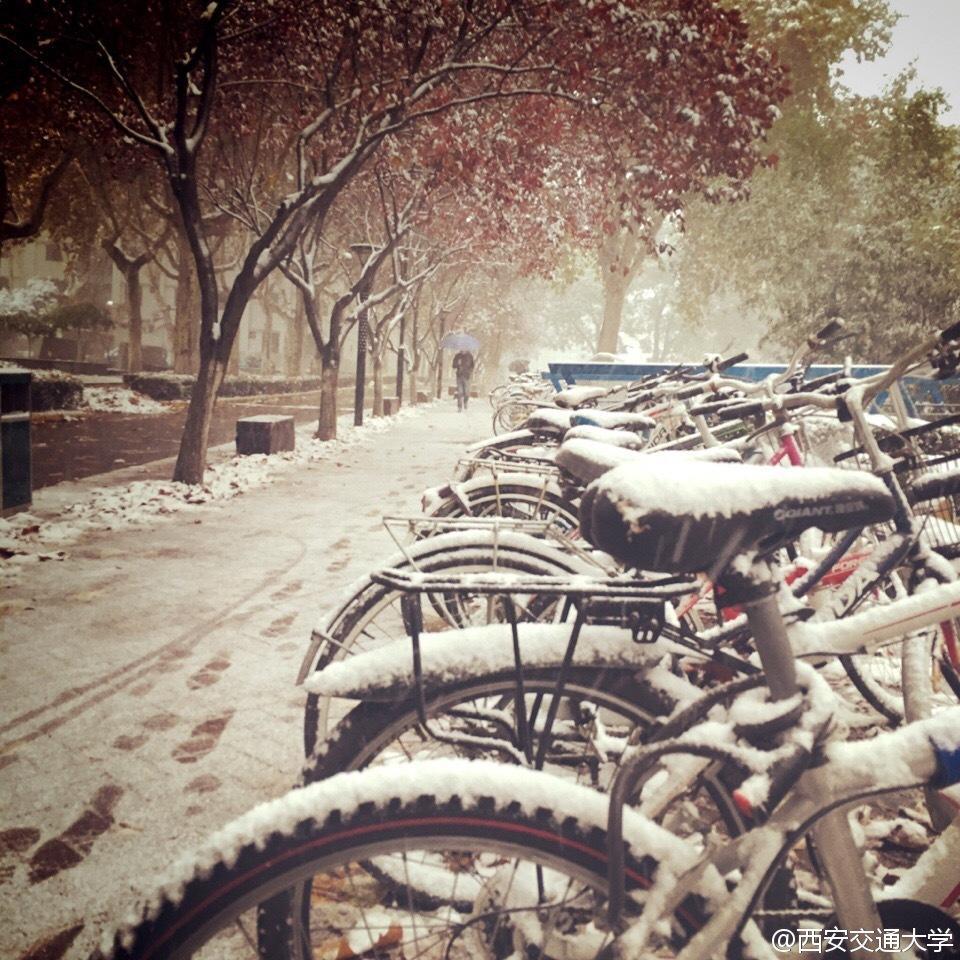
Borrowing an image to set the tone for this post. Why did I choose such a title? Because on my way back to the lab from Kangqiao after dinner today, the scene stirred my emotions, and I felt compelled to express my thoughts.
The Biggest Snowfall Since University (Maybe)
Actually, the snowfall on January 31st this year was even heavier.
I spent the night in the lab the day before yesterday. Since the room is equipped with heating and air conditioning, and we almost never open the windows, it was quite warm. It was only when I stepped out to use the restroom that I felt it was a bit colder than usual. It was dark, so I didn’t think much of it.
—It wasn’t until the next morning when I woke up shivering that I slowly realized it had snowed. The snow continued all day, only stopping around 11 p.m.
Unfortunately, I had stayed overnight in the lab to meet a noon deadline today, so I spent the entire snowy day indoors. It wasn’t until I finished my work in the evening that I decided to return to my dorm for a night’s rest. The night snack vendors deserve praise for their dedication—they still set up their stalls on such a cold night. I decided to support their efforts.
And so, the beautiful snowy scenery was wasted missed by me.
More Interesting Than the Snow Are the Excited Southerners
The above line is meant to be playful.
I personally enjoy expressing reflections and often find myself moved by the scenery, leading to moments of contemplation.
Last year, a classmate invited me to the Big Wild Goose Pagoda. After the music fountain show ended, the bustling square quickly emptied. Gazing at the ancient pagoda, I felt a wave of emotion: It has stood here quietly for a thousand years. In comparison, human life is truly fleeting. And as lonely as snow For a moment, a profound sense of history washed over me, and I was left in awe, savoring the flood of emotions.
We are often moved by scenery because something within us resonates. As Marco Polo described the city of Phyllida to Kublai Khan:
If you find one of the arcades more pleasing than the other, it is because thirty years ago a girl in an embroidered dress with wide sleeves passed by there, or because the light at a certain moment reminded you of another arcade somewhere else.
Like an Audience, Watching Someone Else’s Life
I felt quite sad after returning that day. Why?
I love talking big, discussing life and ideals—it feels exhilarating! Sitting comfortably in a café, pontificating and lamenting the past and present, is certainly carefree. But if, afterward, one fails to internalize the heart’s understanding and apply it to action, like Shi Wen learning the qin, then it’s nothing more than idleness. I’d like to echo Zhu Ziqing and say: This year, I am twenty years old, and I am truly too clever.
Without any real substance, what is there to reflect upon? In high school, I enjoyed criticizing the country and the education system, calling them factories that mass-produce fools. But upon reflection, being such a cynic and making such remarks wouldn’t change the country or education in the slightest. The only thing it accomplishes is venting dissatisfaction, after which one continues to drift in a sea of suffering, making no progress and becoming one of the aforementioned fools.
After recounting all the cities he had visited, Polo summarized to the Khan:
The inferno of the living is not something that will be; if there is one, it is what is already here, the inferno where we live every day, that we form by being together. There are two ways to escape suffering it. The first is easy for many: accept the inferno and become such a part of it that you can no longer see it. The second is risky and demands constant vigilance and apprenticeship: seek and learn to recognize who and what, in the midst of the inferno, are not inferno, then make them endure, give them space.
In fact, both of the passages above were spoken by Calvino through Polo’s voice.
The Greatness of a University Lies in Its Culture
This is a quote from Lu Xun, as recounted by my high school chemistry teacher.
John Henry Newman, the Bishop of Oxford and initiator of the Oxford Movement, stated in his famous lecture “The Idea of a University”:
Gentlemen, if I had to choose between a university where students are supervised by teachers and graduate by earning enough credits, and one without professors or exams where young people live together and learn from each other for three or four years, I would unhesitatingly choose the latter… Why? I think this way: when many intelligent, curious, compassionate, and perceptive young people gather, even without being taught, they can learn from each other. They exchange ideas, discover new perspectives, encounter fresh experiences, and develop unique judgment.
Although Xi’an Jiaotong University follows the former system, it still shines, to some extent, with the brilliance of the latter.
After dinner, I stepped out of Kangqiao and exhaled a few puffs of breath. Despite the cold, it was mealtime, and the area outside the cafeteria was bustling with activity, with soft music playing over the broadcast system. As I walked through the crowd, I overheard snippets of conversation—some discussing their latest research directions, others debating a mechanics problem, and still others talking about the design of something… I felt a touch of emotion and finally realized that most of the people around me were future artists, scientists, and engineers.
Although it was a season of withering after the heavy snow, I witnessed an unprecedented vitality.
How fortunate I am to sing of this aspiration.
Postscript
Having survived the deadline, I let out a long sigh of relief and wrote this piece.